The weathermen in Polk County measure their careers in hurricanes. After they’ve covered two hundred, there’s a commercial on the eight o’clock news. They’re far enough inland that they don’t get the worst of the winds. Everyone in Polk County remembers the name of their first hurricane. Jeanne. Rita. Gordon. Earl. Debbie. No one in Polk County remembers the lost time somebody lost a roof or a mailbox or a dog to the winds and the rain. The weathermen put another tally and another tally on their career. Agnes. Dora. Ike. Opal.
—
His jaw would have made for a handsome face if it weren’t for all of the teeth stuck inside it, jammed on top of one another. Ray Ray’s was a face that would have looked stronger on a taller man. But he was too short for his head and often looked sickly and far too angular. If a hurricane would ever come, it might lift him up by his flat, straight hair and drop him in the Gulf. He would have liked to be lifted up by the hair in a real hurricane.
—
All Polk County had for him were stories. Stories about hurricanes and other things. There were no marks from the storms. New Orleans had its flood lines and Miami had its palms split in half and thrashed away. Even Zephyrhills had a few broken houses.
—
Ray Ray had thought about New Orleans when he was younger and imagined riding the flood waters into the city and kicking through windows and peeling roofs apart at their weak nails. He would sit atop the waters until they dried out and he would run to the river to find more. But now he thought about sitting and waiting for the water to come and turning to lie face down as the lakes and the canals overflowed.
—
Polk County had nothing but stories and weathermen who had covered three hundred hurricanes without having ever boarded a window or flooded a car or tasted the wet wind that stuck between their teeth and pressed their tongues back. They had never known a hurricane and Ray Ray would never know a hurricane. All he would know were emptied out stories, bleached by light rains and smoothed of their flair and guile by the breezes of retelling. Every day he thought about the same stories. The stories held his father and his father’s father and uncles and aunts and aunts-by-friendship in place. No one would listen to their stories anywhere else.
—
His father liked to tell a story about Jai Alai. His father’s father had always gambled on the matches until they outlawed it in Florida. It was still legal in Miami, but it wasn’t worth the five had seen a player break his nose. They could throw the ball one hundred and twenty miles per hour. His father liked to say that the crowed had cheered. They cheered until the player walked off the court. Then they began to boo. He was costing them money. He had been the favorite and it was a Saturday. Saturday was a big betting day. The crowed loved the blood until he quit. His father always laughed at the end of the story. That’s Polk County, he would say. We love violence.
—
Ray Ray wasn’t sure if they loved violence. They never had any violent hurricanes. They didn’t do too many violent things. Polk County hosted two battle reenactments each summer. There was no more high school football in those months. The first commemorated a Civil War skirmish that the county had stolen from southern Georgia. It was unclear who knew that and who didn’t. Ray Ray had only found out in the third summer after he was old enough to watch. He had asked an old man where in Polk the battle had really taken place. He had looked like someone who only had stories, but there had been no one else to talk to. The old man had asked him what he knew about history.
“I know some history,” said Ray Ray.
“What do you know about this battle?” asked the old man.
“It was the only one in Florida.”
“The old man looked towards the field and laughed.
“There weren’t no battles in Florida, son.”
“Except for this one.”
“Not even this one.”
“What do you mean?”
“Too many trees.”
“Too many trees?”
“There are too many trees here.”
“Too many trees for what?”
“For this battle. For all the horses.”
“I don’t see any horses.”
—
Ray Ray tried to imagine a hundred horses standing next to one another. It seemed that they would populate the trees and tear them down if they all ran at once. Ray Ray’s father had owned a horse named Trigger. Ray Ray thought about a picture that he had seen of his father’s horse. It was grey with white spots on its sides and still young when his father’s father sold it. His father had ridden it to school each day. Ray Ray thought his father rode it in middle school. He could not remember if it was middle school or high school. His father had not named Trigger. Ray Ray’s father’s father had bought it for cheap and it already had the name. Ray Ray’s father had taught him to ride but he had been young. He wondered why they stopped riding. His father told him Ray Ray had ridden to fast and fallen off once. Maybe they had stopped riding after that, but Ray Ray thought he would like to have a horse and ride too fast. He would not ride it to school.
—
“They haven’t ridden in yet.”
“Where are they?”
“The soldiers are hiding them.”
“Where are the hiding them?”
The old man turned his head.
“In the trees.”
“How many horses are there.”
“Fifteen on both sides.”
“That doesn’t seem like many horses.”
“It’s a lot for these trees.”
“They should have fifty.”
The old man laughed.
“Is that too many?”
“Too many to run through these trees.”
Ray Ray looked at the tress. There had been no battle here. The stories about the battle were stories about a story. No one had died in Polk County. The battle from the Seminole Wars had at least been real. It had been more of a slaughter than a battle. Ten merchants had attacked a Seminole camp. The Seminoles had been hunting a mile from their village. The merchants thought that was too far from their village. Ray Ray saw it for the first time when he was nine. He had not known they would not be using real guns. The reenactment lasted an hour. The Seminoles did a lot of shouting and then a lot of screaming. Ray Ray knew two of the men playing the merchants. One ran the hardware store and one owned the diner. Ray Ray had wished the Seminoles had real guns.
—
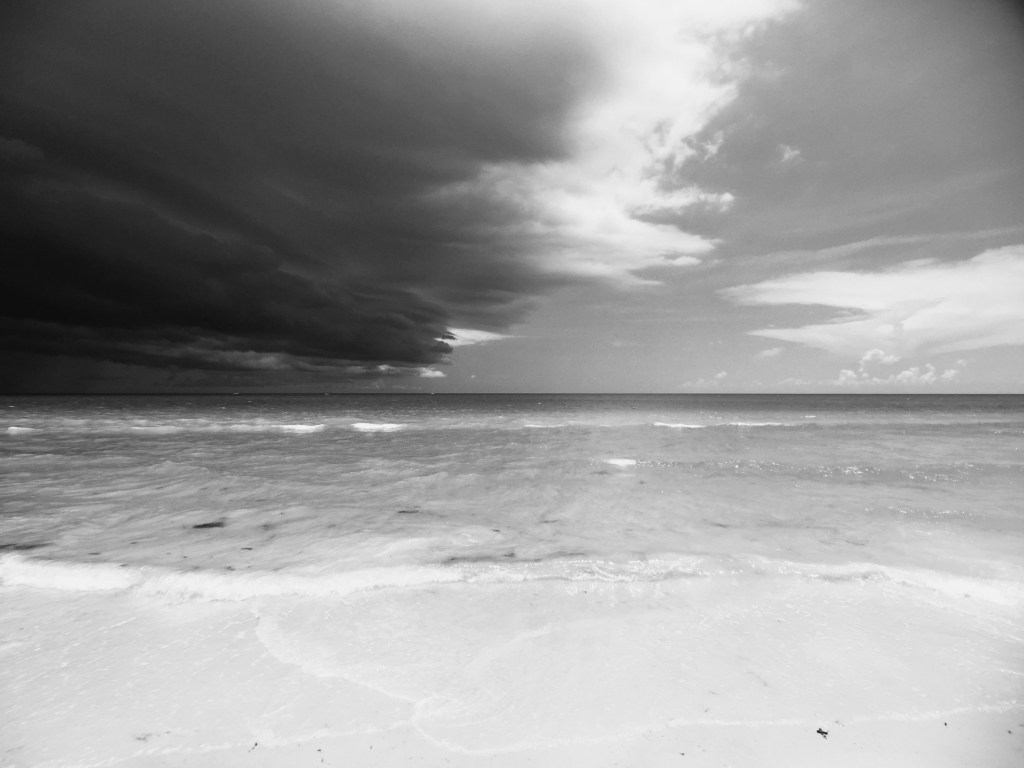
The weathermen had said it would be a Category 4. They called it George. That was the day he decided to leave. If it would be his last day, he would go to the beach. There is only one beach in Polk County. He wasn’t much for beaches, anyway. The worst that could happen at a beach was sunburn. There were no manta rays in Polk County, and no sharks on the West coast of Florida. They preferred the cooler waters of Cocoa Beach and the Atlantic. The waves there were propelled by higher tides and bleaker winds. The beach in Polk County was stone grey and flat, the sand packed hard with wet air and disuse. There were not footprints for the quiet waves to smooth over. He thought about death and about what death would look like on a beach. It would look uninteresting here, low and deflated. It would look better on a white beach, deep but short and cut by the brief dunes furrowed by the high point of the tide. Death would be strange and new there. Here it would be unremarkable. He wondered if anyone would notice death on this beach. He wondered if anyone had ever noticed death in Polk County. He sat at the back of the beach, on the sand furthest from the water. Four minutes after he had closed his eyes the rain came. He knew if had been four minutes because he did not want to sleep and he had counted the seconds between the tapping of thunder from out in front of him. The last Category 4 to hit Jacksonville had pulled the columns away from the front of the county courthouse and almost flooded the Old City in St. Augustine. The thunder that day would not have awoken Ray if he had dozed off. The rain was only enough to make him leave the beach because it was a cool day. It had barely wet his hair and he could still dry himself with his towel.
—
Ray Ray’s father had told him about choosing the name Ray Ray.
“Did I ever tell you how we named you?”
“I don’t think so.”
“Did I every introduce you to Ray McCloud?”
“No, sir.”
“He passed away last year.”
“Was he your friend?”
“Nope, he painted the house back when we first ought it.”
“How long ago was that?”
“Nineteen years ago. Right when I married you mother.”
“Why would you introduce me to him?”
“You’re named after him.”
“But he wasn’t your friend.”
“I didn’t know anyone else in this county named Ray.”
“So why didn’t you just name me Ray?”
“Do you like your name?”
“Yes, sir. I don’t know anyone else named Ray Ray.”
“That’s why I didn’t just name you Ray.”
Ray wondered if death would look different on the beach because he was named Ray twice. He wondered if Polk County would know if its only Ray Ray died. He wondered if the sand would look a little whiter and if death wouldn’t look so normal on the beach for Ray Ray.
—
Ray Ray’s only job at been at a fruit stand. There were fruit stands with huge billboard with oranges with eyes and smiles. Ray Ray had not worked at one of those fruit stands. It had a wooden sign that say “Strawberries.” It was one of three stands near a tall piece of stone said “Welcome to Polk County.” Ray Ray had always wondered why Polk County welcomed visitors with a tall tombstone. It was tall enough to shade the first two fruit stands. The third worker to arrive each morning would be in the sun all day. The sun in Polk County was hot and the tombstone shade was cool. His boss drove by in his truck once a day. He owned seven stands. He never left the truck, just waved when he saw that someone was working. He would have found someone new after he drove past an empty stand a few times. It wouldn’t have been the first time he found a new worker without warning. But Ray Ray had time to tell his boss he wouldn’t be back. So he walked to the fruit stand and waited for the truck to drive by with a wave. This time he waved back and ran to the road. The truck slowed down and stopped.
“Ray Ray, I gotta make my rounds.”
“I know, Boss. But it’s my last day.”
“Alright, Ray Ray. I gotta find a new guy.”
“Sorry, Boss. You’ll find someone.”
“I know, Ray Ray. I always do.”
“Yes, sir.”
“You find a new job? Too good for my stand now?”
“No, sir, boss, I’m headed out of here.”
“Out of where?”
“Out of here, boss.”
“Where to?”
“South, maybe.”
“Why South?”
“I want to try fishing, boss.”
“Alright, Ray Ray, good luck.”
The truck clicked into gear and pulled back onto the road.
—
Ray Ray hitchhiked South. He was in Cape Coral in twelve hours. There were fishing boats docked in the harbor. Ray Ray had heard a few boat stories in Polk County.
There were more boats here so he thought they would have had more boat stories. He had found his job at the fruit stand by asking the owner if he could work there. So he walked until he saw a building with a huge shrimp painted on its side. The building was concrete painted pink and the shrimp was white outlined in bright blue. He was glad the concrete was not sandy grey. He walked inside asked if he needed to fill out an application. The man behind the counter barely looked up.
“You ever been on a boat, son?”
“Yes, sir, twice, I think.”
“Just twice.”
“I think it was twice. It might have been three times.”
“Three times is good enough. You from Florida.”
“I’m from Polk County.”
“Oh, Polk County. Y’all are all warm and safe up there. No wind and no floods.”
“Yes, sir. That’s what everybody tells me.”
“So why are you down here?”
“Everybody keeps telling me the same stories. I work at a fruit stand.”
“Ain’t no action at a fruit stand, son.”
—
Ray Ray thought about the stand and how he had sat behind it looking at the road. The two stand nearby each had two workers and Ray Ray listened to their conversations. They often talked about the fruit business and business of growing fruit. Ray Ray thought about the trees that grew oranges and grapefruit and tried not to think about the short, round bushes that grew strawberries in the dirty soil. He wondered if the oranges were burned by the sun and why grapefruits had lighter skin that did not burn. He wondered how he would burn as he dangled at the end of a branch. He would be too heavy and weigh the branch down, pulling the tree always to one side. He hoped the tree would lean towards the Sun so he would burn more quickly. He would be the color of a grapefruit and then turn orange and burn past that orange to red until there was no more skin and the sweet juice was burned from inside of him and all that was left was flaky flesh. And he would fall from the tree.
—
“That’s true, sir.”
“I see, I see. So how about I tell you about fishing?”
“Yes, sir.”
“Do you know what can happen to you on a fishing boat?”
“You can make some money.”
“Oh, yes you can. What else can happen.”
“That’s all I know.”
“A fishing boat can kill you.”
“I didn’t know that.”
“If you fall off a tall enough fishing boat you’ll die when you hit the water.”
“Won’t you float?”
“You’d float if all your bones didn’t break when you hit the water. You can get killed by the anchor too.”
“Is that it?”
“You might get caught in the net and lose an arm. And we get caught in the storms on long trips.”
“Which storms?
“The big ones. You’ve probably never seen one in Polk County.”
“No, sir.”
Ray Ray wondered what a hurricane would be like on a boat. The waves would be big enough for surfers, he thought. He knew surfers could die under waves. He wondered if the boats could die under the waves too. He wanted to ask. He wondered if he might make the man angry. Ray Ray needed the job. He wanted anger later, out on the waves, not here. He didn’t ask.
 Brian Aubrey Smith
Leave a comment